It’s time to take action on your school’s electricity use!
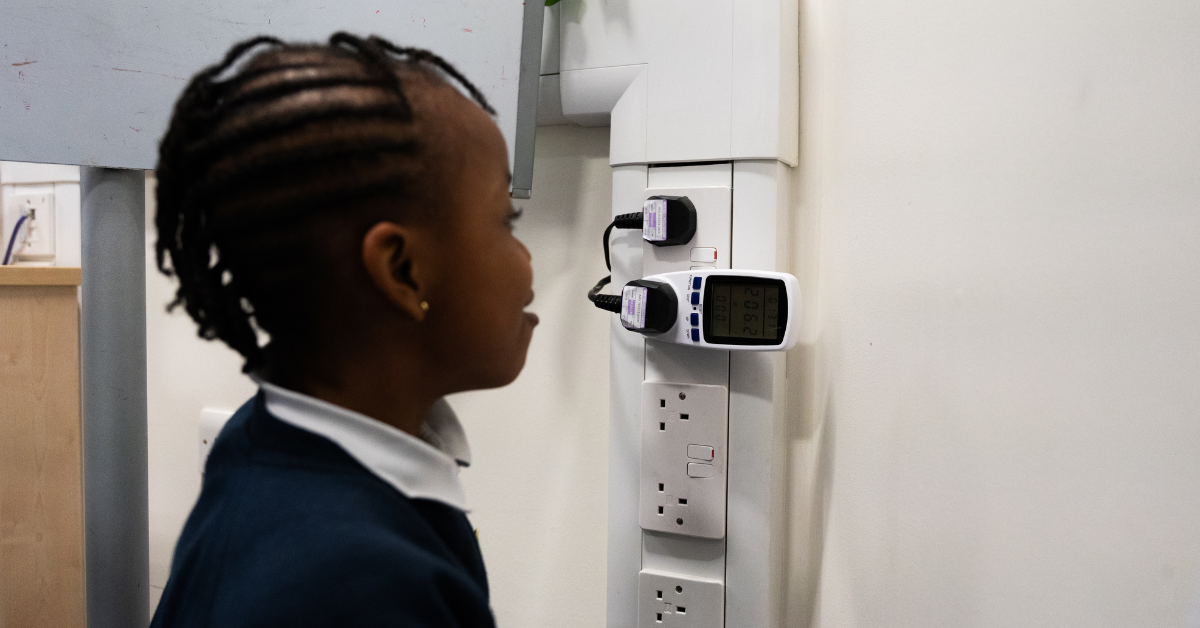
Reducing your school’s out-of-hours electricity use is a surefire way to save money and cut carbon, but it takes a team effort. So as the sun starts to shine, it’s time for your students to shine!
With winter behind us, hopefully by now your school’s heating has been – or soon will be – switched off.
So, as the heating season draws to an end, now is an ideal time to shift your focus on how to cut your school’s electricity use.
On average, schools use over 60% of their electricity when they are closed to students, so reducing this can be one of the quickest ways to cut your energy use. And because electricity is expensive, it is also a great way to save money on school energy bills.
Reducing baseload by just 1 kW can save 8,760 kWh per year, in turn saving at least £1,300 a year (depending on your electricity rate), and around 1,700 kg CO₂ annually.
Below, we explore a couple of ways you can use Energy Sparks to help you.
Out of hours electricity page
The Analysis tab of your Out of school hours electricity advice page is a great place to start (here’s how to find it).
This page provides a range of useful information to help you understand how your school is performing, including:
- How your electricity use was split between school hours, evenings, weekends, holidays, and community use times over the last year.
- A breakdown of your electricity use by day of the week, and time of use (school hours, weekends, holidays etc).
- A summary of your electricity usage during the last two years of school holidays*. So if you implement a new holiday switch-off routine, you can check back to see how much difference it’s made.
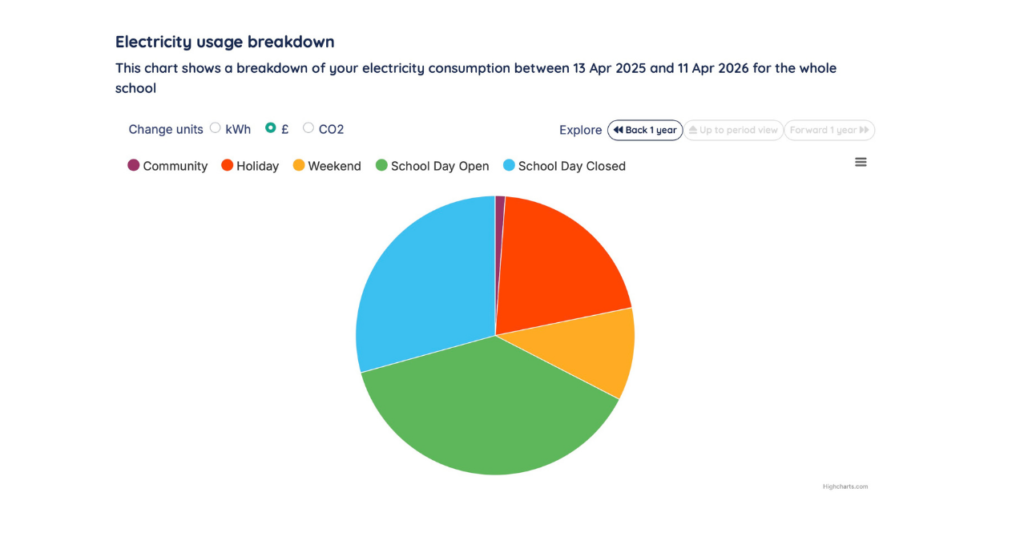
Above: Example chart showing the proportion of electricity being used when the school is open to students, when it is closed, during weekends and holidays, and during community use times.
You can also use the information on this page to help you communicate with staff and students, and track your progress.
We recommend that all schools put together a holiday switch-off checklist to run through at the end of term. Even when schools are in use during holidays it’s very rare that they are fully occupied. This is an easy way to make savings without impacting the everyday running of your school.
* Where we have enough data.
Electricity baseload
Another really good way to reduce your out of hours electricity use is to concentrate on your baseload, which is the electricity needed to provide power to appliances that keep running at all times.
A school’s baseload is usually measured by looking at the power a school consumes out of hours when the school is unoccupied. This is one of the most useful benchmarks for understanding a school’s electricity use.
If your school has a high electricity baseload, it suggests that electrical appliances or systems are being left on all the time, possibly unnecessarily.
All schools should aim to reduce their electricity baseload per pupil to that of the best schools. Schools perform roughly the same function so should be able to achieve similar electricity consumption, particularly out of hours.
Energy Sparks carries out a range of analysis on your baseload to help you understand how to improve it.
How do I know if high baseload is an issue at my school?
If your school is signed up with Energy Sparks, the quickest way to find out whether you need to take action on baseload is to look at your Energy Saving Opportunities page – here’s how to find it.
There, you will see a table showing your prioritised opportunities – you can sort this by potential savings in energy (kWh), cost, or CO2.
Here’s an example of what the table looks like for one of our schools:
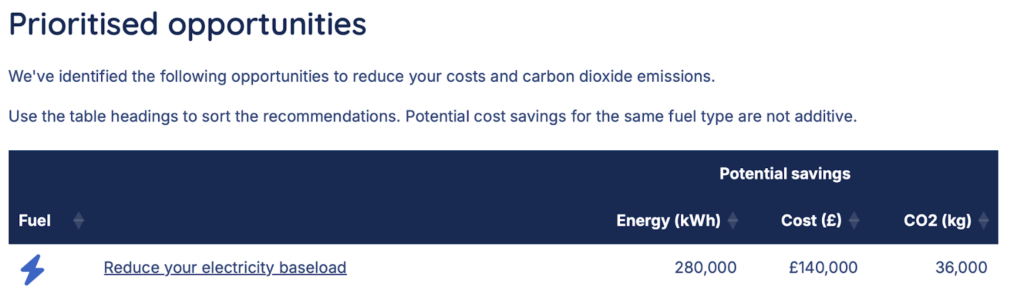
Many schools will see “Reduce your electricity baseload” at or near the top of their table. Clicking on the underlined text will take you to your Baseload advice page, where we present a range of analysis to help you identify the causes.

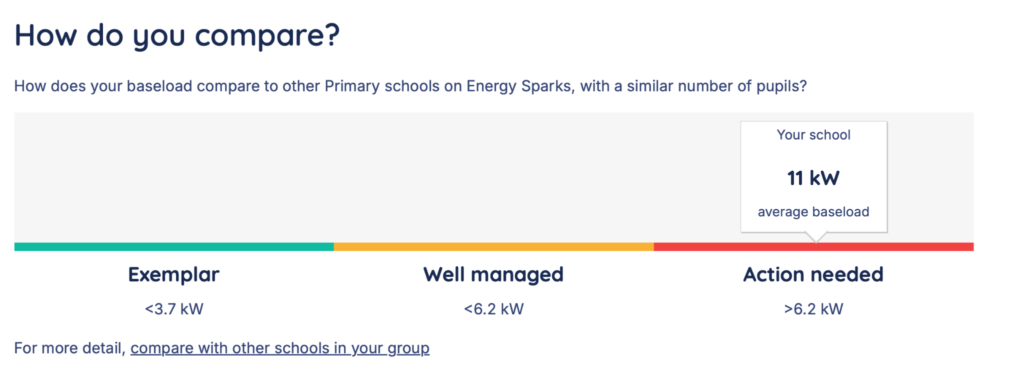
You can also see how your baseload compares to other similar schools by looking at the insights tab of your Baseload advice page – it will look something like this:
Baseload – what to look for in your data
1. High baseload
If your charts show that your school’s baseload is much higher than other similar schools, you could try carrying out a baseload audit. You can learn more about how to do this, and use our free tool here.
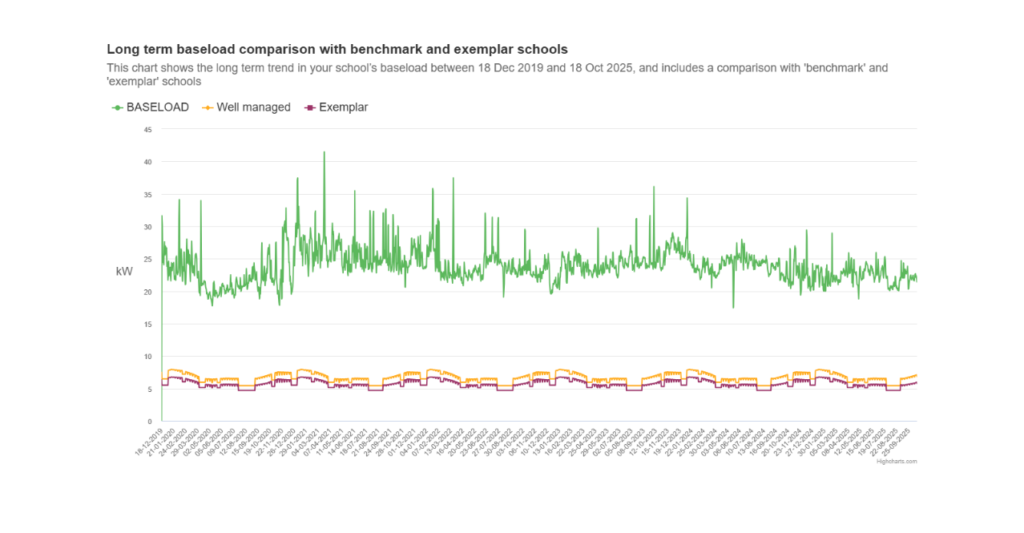
Above: Example of a chart from a school whose baseload (green) is much higher than schools of a similar size and type whose baseload is well-managed (yellow) and exemplar (purple).
Other actions you could take could include:
- Setting an automatic ICT switch off
- Using an appliance monitor to check how much energy your fridges and freezers are using – older models (or those in need of maintenance) often use a lot of electricity out of hours.
- Adjusting server room aircon temperature, or consider moving servers to the cloud.
For more like this, take a look at our suggested actions around operational change and upgrades to appliances.
2. A sudden increase in baseload
You might notice a sudden increase in your school’s baseload. This sometimes happens if a new piece of equipment gets installed, or if something has been serviced and timers are changed.
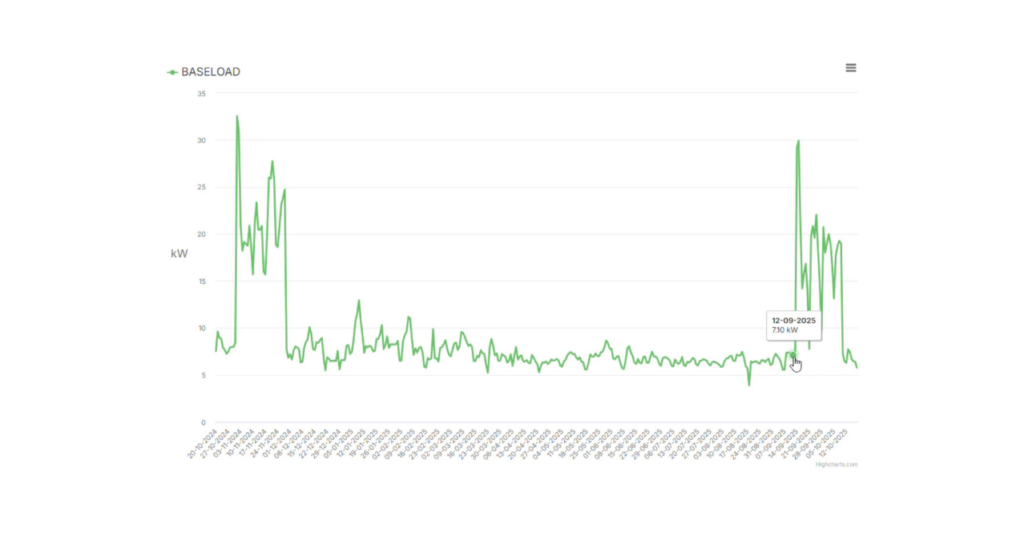
Above: Example chart displaying two sudden peaks in electricity baseload.
If you are seeing this in your charts, the first thing to do is find out when this happened. You can do this by clicking on any point in your baseload chart to zoom in and see your full electricity usage on that day (you might need to click the ‘forward/back one day’ button to spot exactly when the change happened).
When you find the date of the change, see if you can find out what happened on that day. Think about:
- Whether this is a one off, or a regular occurrence
- What was happening on this day
- Who was in the school
- If you had engineers in
- Whether anyone did routine maintenance or changing of settings
- Whether you had something new installed – might it have been set up incorrectly? Or is it very energy intensive (like a temporary swimming pool)?
Top tip: Alerts can tell you if there are sudden, unexpected changes.
Make sure key people at your school are signed up to receive these.
3. A large variation in baseload
At a well-managed school, baseload should remain the same throughout the year. Whether it is winter or summer, a weekday or a weekend, the amount of electricity your school is using overnight should be very similar.
In practice, however, this is often not the case.
Weekday variation
Some schools will have a large weekday variation, such as the one shown below. You can see a repeating pattern of high and low consumption throughout the year.
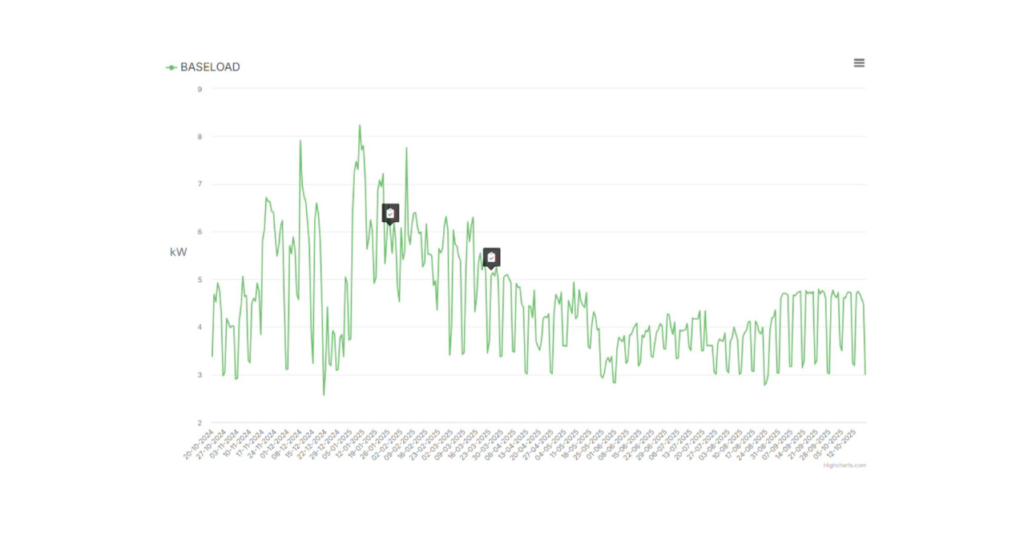
Above: Example chart showing clear repeating weekly pattern.
If your baseload chart looks like this, find out what is causing your baseload to be higher on certain days of the week, and switch off the equipment or lights causing the difference.
A common cause of weekday variation is that school staff are often better at switching off on Friday evenings than at the end of the day during the rest of the week. If that’s the case at your school, adding classroom switch-off checklists and appointing pupil energy monitors to make sure things are switched off can help. Another good solution is to fit timers.
Daily variation can also be caused by automatic timers that fire equipment up on a Monday morning and turn it off on a Friday night. If that’s the case, you can simply change the timers so that they switch things off every evening.
Another common cause is inefficient security lighting. If you discover that this is the case at your school, you might want to think about potential upgrades – your Energy Sparks charts can help you to understand the likely return (through cost savings) of any investment you make.
Seasonal variation
Many schools also show a large seasonal variation – where overnight consumption is higher during the winter, as shown in the example chart below.
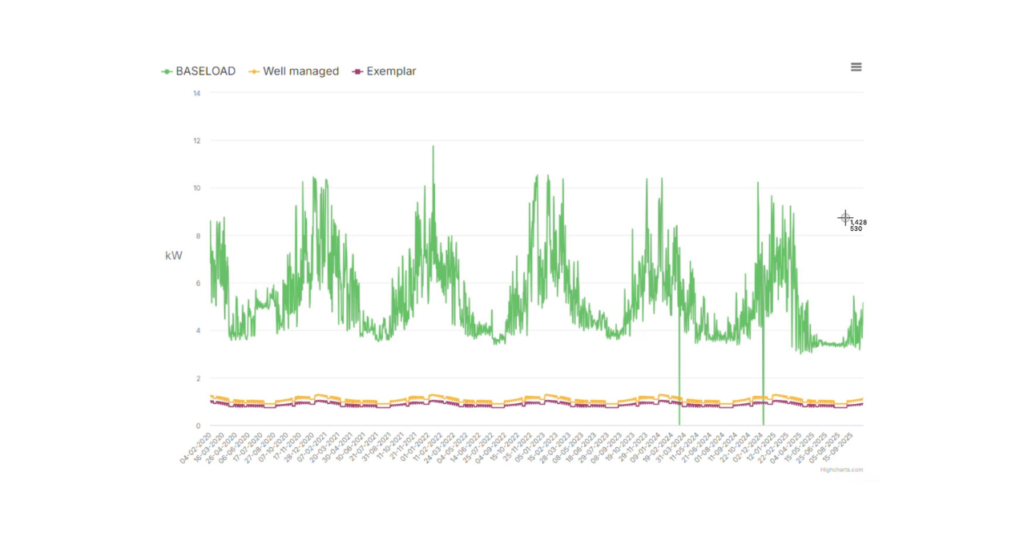
Above: Example chart showing repeating seasonal pattern of high winter baseload
and low summer baseload.
Large seasonal variation is usually caused by electric heating that gets left on overnight, for example:
- Heating that uses electricity
- Fully electric heating
- Gas heating that requires electricity to power things like pumps, fans and air handling units
- Portable heaters
By identifying this, you can either switch off equipment that is coming on unnecessarily, or adjust heating settings to bring your energy use down.
Inspiration time!
Birchgrove Comprehensive in Swansea used Energy Sparks to target their baseload and reduce holiday energy consumption. This saved them over £4,000 and almost 4 tonnes CO2 during the summer holiday in 2023. Learn more.
Get started…
We’ll be sharing ideas and information to help schools cut electricity use this summer – sign up to our newsletter and follow us on LinkedIn to stay up-to-date.
If you’re ready to dive in, a great place to get started is with our Beat your baseload programme, which will help your school community work together to reduce the amount of electricity running in the background at your school.
